
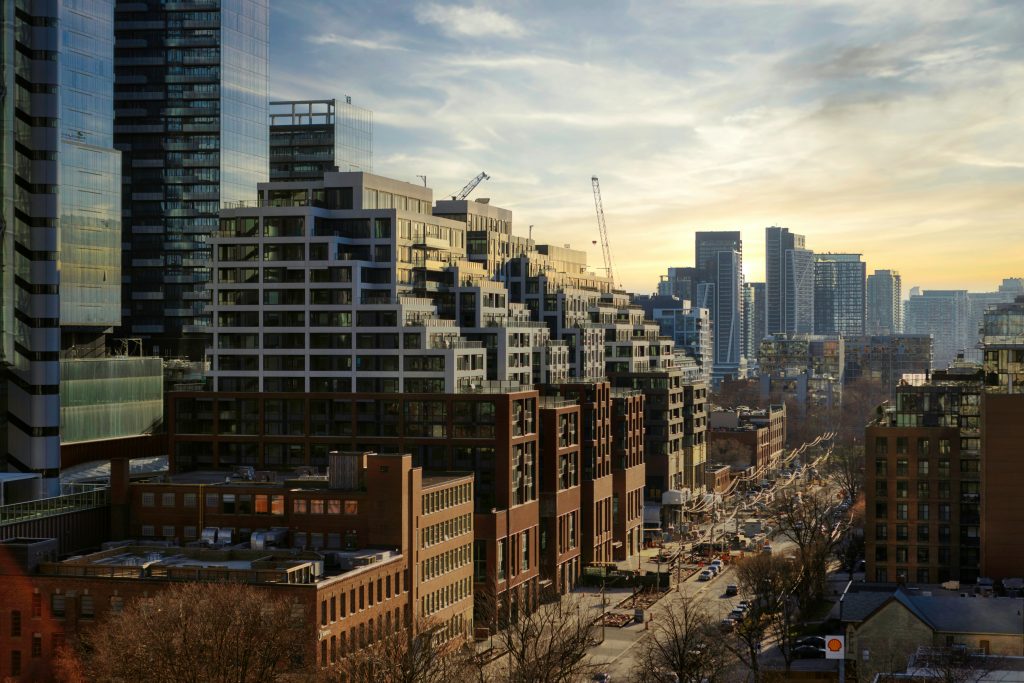
For many buyers in the Greater Toronto Area, condo fees are one of the most misunderstood aspects of ownership. They’re often perceived as an added expense — and in many cases, assumed to make condos more expensive than freehold homes. In reality, condo fees are simply a structured way of covering costs that exist regardless of property type. The difference is that with a condo, those expenses are consolidated into a predictable monthly fee, whereas with a freehold, they’re paid separately and often less visibly over time — a distinction that’s important to understand when comparing true ownership costs.
Understanding what condo fees include, and how they are calculated, is essential when evaluating the true cost of owning a condo in Toronto.
- What Are Condo Fees?
- What Do Condo Fees Cover?
- What About Parking and Lockers?
- What Do Condo Fees Cost in the GTA?
- Why Do Condo Fees Increase?
- What Should Buyers Review?
- How Does This Compare To A Freehold Home?
1. What Are Condo Fees?
Condo fees (also known as maintenance fees) are mandatory monthly payments made by every condo owner to the condominium corporation. These fees are required under Ontario’s Condominium Act and are used to operate, maintain, and repair the building’s shared spaces and systems. Each owner contributes based on their unit’s percentage of ownership, typically tied to the unit’s size. The building sets an annual budget, and that total is divided among owners and paid monthly.
2. What Do Condo Fees Cover?
Condo fees are generally divided into two main categories: day-to-day operating costs and long-term reserve funding.
On a practical level, fees typically cover:
- Maintenance and cleaning of common areas such as hallways, lobbies, elevators, and amenities
- Landscaping, snow removal, and garbage collection
- Utilities for shared spaces, and sometimes heat or water within units, depending on the building
- Building insurance for the structure and common elements
- Staffing and services, including concierge, security, and property management
- Routine repairs and upkeep, such as window cleaning and pest control
In addition to these operating costs, a portion of every fee goes into a reserve fund for major future repairs, such as roof replacements, elevator upgrades, or structural work.
3. What About Parking and Lockers?
Parking spaces and lockers are often considered “exclusive use” common elements. While they are assigned to individual units, they still require maintenance and servicing. As a result, there are typically additional monthly costs for these features, covering lighting, cleaning, ventilation, and security for those areas.
4. What Do Condo Fees Cost in the GTA?
In the GTA, condo fees typically range from $0.75 to $1.25+ per square foot per month, depending on the building’s age, size, and amenities. Newer buildings often fall on the lower end of this range, while older buildings or those with more extensive amenities may have higher fees. Buildings closer to the core or in prime locations tend to be a premium as well. For example, a 800-square-foot unit in a mid-range Toronto building may have monthly fees of $750 to $850 in the core and $550 to $700 outside the core.
5. Why Do Condo Fees Increase?
Condo fees can increase over time due to rising utility costs, insurance premiums, inflation, and updated reserve fund requirements. Newer buildings have less predictable fees as well as the condo board gets its footing and potential problems become apparent.
In some cases, buildings may also require special assessments, which are one-time charges used to cover unexpected repairs or funding shortfalls. These situations are often tied to inadequate reserve planning or unforeseen building issues.
6. What Should Buyers Review?
For buyers considering a resale condo, reviewing the status certificate is essential. This document outlines the building’s financial health, reserve fund balance, and any upcoming fee increases or special assessments.
For pre-construction purchases, reviewing the projected first-year budget can help gauge how fees may evolve once the building is complete.
7. How does this compare to owning a freehold home?
Condo fees are often viewed as an added expense, but in reality they represent a structured, predictable approach to ongoing maintenance and long-term capital costs. In Toronto, this typically translates to ~$600–$900/month for a condo, covering building operations, maintenance, and contributions to the reserve fund. With a freehold, those same costs still exist — just less visibly — often ranging closer to $800–$2,000+ per month when factoring in ongoing upkeep and long-term repairs. The key difference isn’t necessarily cost, but how and when it’s managed — predictable and shared versus individual and often irregular.
Conclusion
Condo fees are not just an added expense. They are a structured way to manage the ongoing costs of property ownership in a shared environment. Understanding how they work helps Toronto and GTA buyers compare options more accurately and make informed decisions that balance lifestyle and long-term financial planning.
Visit the Condominium Authority of Ontario for more details on condo fees.
Are you ready to move to the next stage? Let’s chat. Send me an email (hillary@hillarylane.ca) or text/phone (416-882-4707).